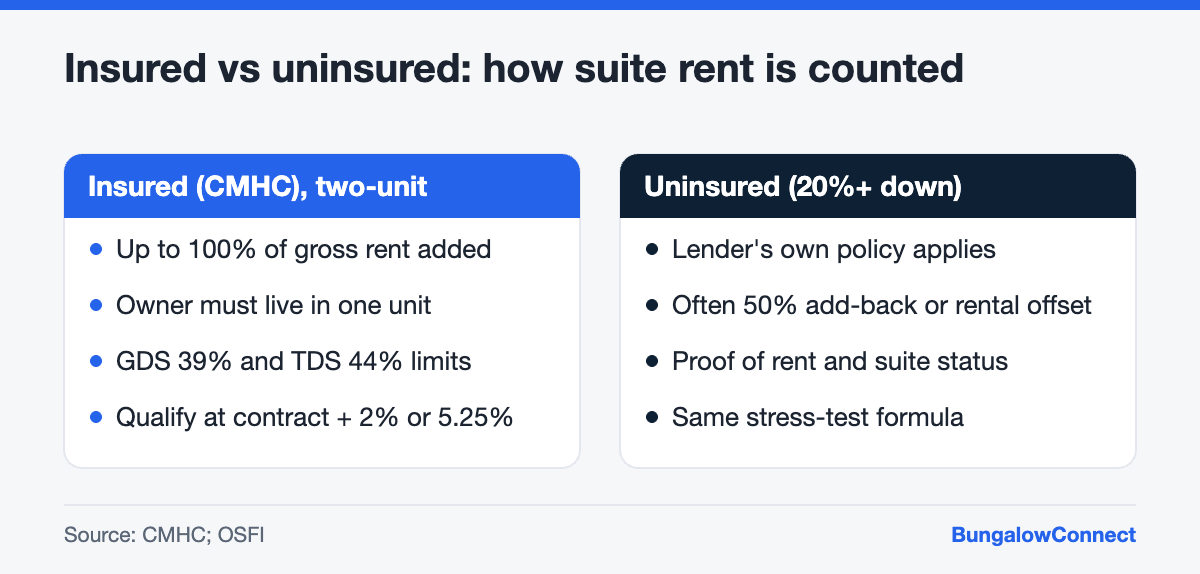
Yes, rent from a basement suite can help you qualify for a mortgage, and for an insured mortgage on an owner-occupied two-unit bungalow, CMHC allows up to 100% of the gross rent to be added to your income. Uninsured lenders set their own rules and often count only part of it. The method your lender uses can decide whether you are approved.
Key takeaways
- CMHC’s rule for an owner-occupied two-unit home is the “up to 100 percent gross rental income approach.”
- For three- and four-unit homes, CMHC uses up to 50% of gross rent or a net rental approach.
- Uninsured lenders commonly use a 50% add-back or a rental offset, and policies vary.
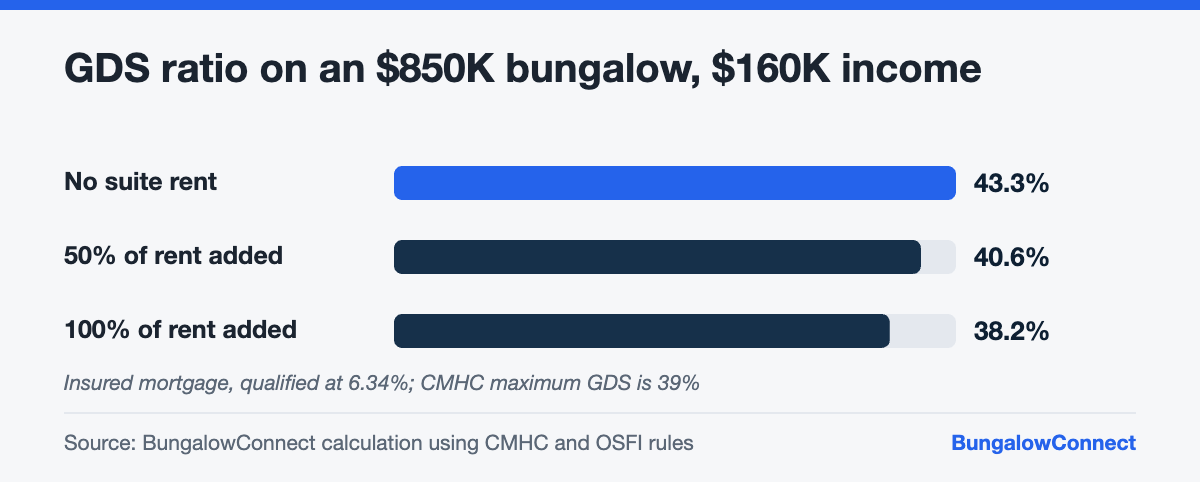
- In our example, suite rent turns a 43.3% GDS ratio into 38.2%, under CMHC’s 39% cap.
- Lenders want proof: a lease, an appraiser’s rent estimate and a unit that meets their standards.
How lenders measure what you can afford
Every Canadian lender checks two ratios. Gross debt service (GDS) is your housing costs (mortgage payment, property tax and heat) as a share of gross income. Total debt service (TDS) adds your other debts, such as car loans and credit cards. For insured mortgages, CMHC caps GDS at 39% and TDS at 44%.
The payment used in those ratios is not your actual payment. It is calculated at the stress-test rate: the greater of your contract rate plus 2% or 5.25%, under rules set by OSFI for uninsured mortgages and matched for insured ones. At today’s best insured 5-year fixed of about 4.34%, that means qualifying at 6.34%.
Rental income can enter the math in two ways: as extra income (an add-back) or as a reduction in housing costs (an offset). The second is usually more generous, which is why the method matters.
The CMHC rule for a bungalow with one suite
CMHC’s rental income guidance for lenders sets out the approach by property type:
| Property you are buying | CMHC approach to rent |
|---|---|
| Owner-occupied, 2 units (bungalow plus basement suite) | Up to 100% of gross rental income added to income |
| Owner-occupied, 3 to 4 units | Up to 50% of gross rent added, or the net rental income approach |
| Other rental properties you own (2 to 4 units) | 50% gross or net approach, with that property’s costs counted |
CMHC notes that the net approach (rent minus operating expenses) is permitted but “not likely to be used” for these files. In practice, the lender and insurer decide how much of the rent is supportable, so the 100% figure is a ceiling, not a guarantee.
Worked example: an $850,000 bungalow with a legal suite
Here is a buyer with $160,000 of household income, buying an $850,000 bungalow with a legal basement apartment rented at $1,800 a month. We assumed $5,000 a year in property tax, $1,800 in heating and a $500-a-month car payment.
Insured purchase, 10% down
With $85,000 down (the minimum would be $60,000), the loan is $765,000. The CMHC premium at 90% loan-to-value is 3.10%, or $23,715, which is added to the mortgage for a total of $788,715 over 25 years. Ontario’s 8% sales tax on the premium, $1,897.20, is paid in cash at closing.
The actual payment at 4.34% is $4,295.44 a month. The qualifying payment at 6.34% is $5,206.74, or about $62,481 a year.
| How rent is counted | Qualifying income | GDS | TDS | Result |
|---|---|---|---|---|
| Not counted | $160,000 | 43.3% | 47.1% | Declined |
| 50% added ($10,800) | $170,800 | 40.6% | 44.1% | Declined |
| 100% added ($21,600) | $181,600 | 38.2% | 41.5% | Approved |
Uninsured purchase, 20% down
With $170,000 down, the loan is $680,000 and qualifies at 7.09% (Nesto’s 5.09% uninsured rate plus 2%), a payment of $4,800.67 a month. Without rent, GDS is 40.3% and TDS is 44.0%, just over common limits. Adding back 50% of rent brings them to 37.7% and 41.2%. A 50% rental offset, which subtracts half the rent from housing costs instead, brings them to 33.5% and 37.3%.
The same suite produces three different answers depending on the lender’s method. That is why a mortgage agent who knows two-unit files is worth the call. If you are still holding a rate, see our guide to mortgage rate holds so a rate increase does not undo the math.
What lenders need to see before they count the rent
- A lease or a market rent estimate. If the suite is tenanted, expect to provide the lease and proof of payments. If it is vacant, the appraiser usually estimates market rent.
- A self-contained unit. Its own kitchen, bathroom and entrance. Bungalows with a separate entrance make this easier to prove.
- Suite status. Many lenders want the unit to be legal or at least conforming. A suite that cannot be legalized may be valued as a basement rec room, with no rent counted.
- Owner occupancy. The 100% CMHC approach applies to owner-occupied two-unit homes. If you will not live there, it is an investment purchase with different rules and larger down payments.
Tip: When you shortlist a bungalow with a suite, ask the listing agent for the lease, the rent history and any permits or fire inspection records for the unit before you offer. Send them to your lender the same day. The answer to “will you count this rent?” is the most important number in a two-unit purchase.
Watch the tenant and tax side too
Buying a bungalow with an existing tenant means inheriting their lease and rights under Ontario’s Residential Tenancies Act. Our guide to buying a tenanted bungalow covers what to check. Rent is also taxable income, and adding a suite can affect your principal residence exemption when you sell, so talk to an accountant early.
If you are adding a suite after you buy rather than buying one ready-made, the lender cannot count rent that does not exist yet. Our article on financing a basement suite in 2026 covers refinancing and other routes.
Frequently asked questions
Can I use future rental income to qualify for a mortgage?
Usually only if the suite already exists. Lenders will often accept an appraiser’s market rent estimate for a vacant, self-contained unit, but they will not count rent from a suite you plan to build later. Some refinancing or renovation programs work differently, so ask a mortgage agent if construction is part of your plan.
Does the basement suite need to be legal for a lender to count the rent?
Policies differ, but many lenders and insurers want the unit to be legal, registered where required, or at least conforming to local rules. An illegal suite may still be valued as finished space, while the rent is ignored. Always confirm before you firm up an offer that depends on the rental income.
Can first-time buyers use suite rent with a 30-year amortization?
First-time buyers can get a 30-year insured amortization through CMHC’s Home Start product, at a premium about 0.20 points higher than standard. Rental income rules for an owner-occupied two-unit home still apply, and the longer amortization lowers the qualifying payment, which can help a tight file.
Is rental income from a basement suite taxable?
Yes. Rent is reported on your tax return, and you can deduct a reasonable share of expenses such as utilities, insurance and repairs. Claiming depreciation on the suite, or making structural changes to create it, can affect your principal residence exemption, so get tax advice before you file.
Find a bungalow that pays part of the mortgage
Browse investor-friendly bungalows and homes with separate entrances, then run your numbers through our mortgage calculators before you book showings.
This article is general information as of October 2026, not legal, tax, mortgage or financial advice. Rules and numbers change, so confirm the details for your situation with a licensed professional.