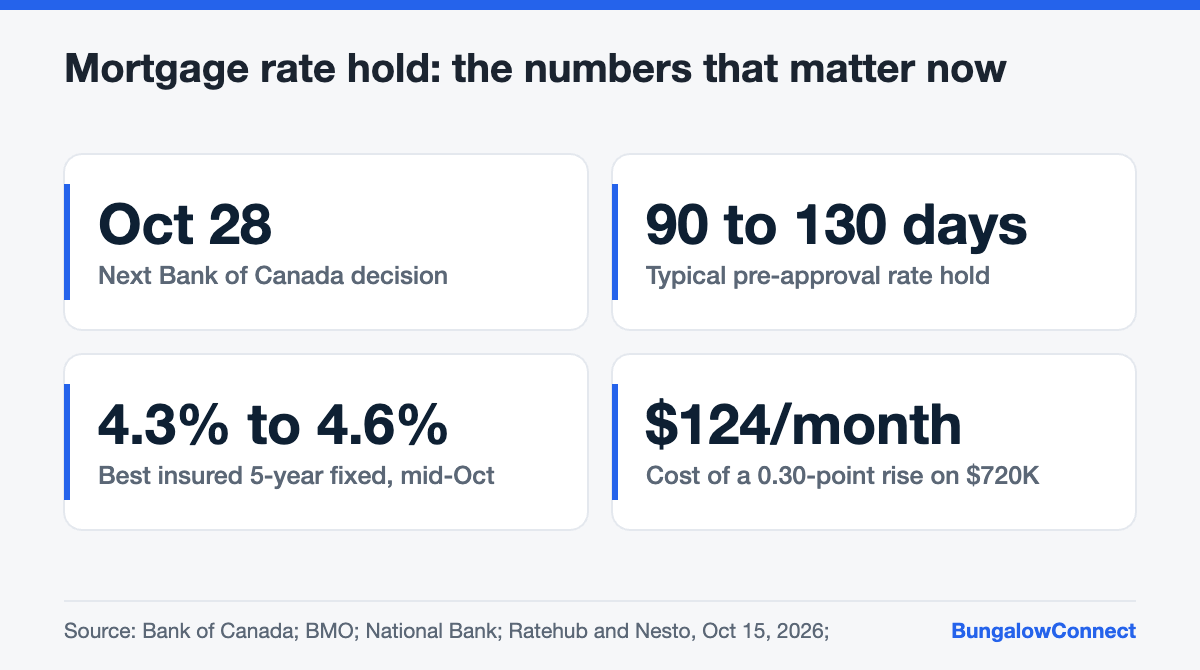
A mortgage rate hold is a lender’s promise to give you a specific rate if your mortgage funds within a set window, usually 90 to 130 days. If rates rise before you buy, you keep the lower rate. With every big bank raising fixed rates between September and mid-October 2026, and a Bank of Canada decision on October 28, a hold is the cheapest insurance a bungalow buyer can get.
Key takeaways
- A rate hold usually comes with a pre-approval and costs nothing.
- Holds commonly run 90 to 130 days; BMO advertises 130 and National Bank up to 120.
- On a $720,000 mortgage, a 0.30-point rise adds about $124 a month.
- The hold only helps if your closing date falls inside it.
- Older bungalows can fail the lender’s property approval even when you qualify.
Why fixed rates are moving now
Fixed mortgage rates follow bond yields, not the Bank of Canada’s policy rate directly. The 5-year Government of Canada bond yield hit a 52-week high of 3.729% on September 28, and all six big banks raised fixed rates between September and mid-October. BMO, for example, moved its 5-year fixed to 5.14% uninsured on October 7. Discounted rates are lower, but they have moved too: in mid-October the best insured 5-year fixed rates were roughly 4.3% to 4.6%.
The policy rate itself has been 2.25% since October 2025, and the Bank held at every 2026 meeting so far. In September it said upside risks to inflation had increased, and some analysts now talk about a possible hike at one of the last two scheduled meetings of 2026: October 28 and December 9. Variable rates (best discounts around 3.4% to 3.5%, roughly prime minus 1.0) would move only if the Bank does.
Our preview of the October 28 rate decision covers the scenarios. This article is about protecting yourself whichever way it goes.
How does a mortgage rate hold work?
When a lender pre-approves you, it reviews your income, debts and credit, then reserves a rate for a set period. If the lender’s rate for that product goes up, you keep the held rate. If you find a home and firm up a deal before the hold expires, the lender then underwrites the actual property and, if everything checks out, issues a commitment at the held rate.
Three details matter more than the headline number:
- Length. BMO’s pre-approval page says terms are locked for 130 days. National Bank’s says a rate can be guaranteed for up to 120 days, although another table on the same page says 90, so confirm in writing.
- Product. The hold applies to a specific term and type, for example a 5-year fixed, insured. Switching to an uninsured mortgage or a different term can change the rate.
- Conditions. BMO states the pre-approval is subject to no material change in the information you provided. A new car loan or a job change can undo it.
What if rates fall after you lock?
Policies differ. Some lenders will give you the lower rate if their rate for your product drops before funding, but this is not automatic and the published pre-approval pages above only promise protection against increases. Ask the question directly and get the answer in an email.
What a rate increase costs on a bungalow mortgage
Say you buy a $900,000 bungalow with 20% down, leaving a $720,000 mortgage over 25 years. We ran the numbers at an uninsured 5.09% (Nesto’s Ontario rate on October 15) and at 5.39%, a 0.30-point rise.
| Scenario | Contract rate | Monthly payment | Stress-test rate |
|---|---|---|---|
| Rate held today | 5.09% | $4,224.52 | 7.09% |
| Rate after a 0.30-point rise | 5.39% | $4,348.83 | 7.39% |
| Difference | 0.30 points | $124.31 a month | 0.30 points |
Over a 5-year term that is about $7,458 in extra payments. The bigger problem can be qualifying. Uninsured borrowers must pass the OSFI stress test at the greater of the contract rate plus 2% or 5.25%. Assuming $6,000 a year in property tax and $1,800 in heating, the household income needed to keep housing costs at 39% of income rises from about $176,400 to $180,500. If your pre-approval was tight, a rate increase can shrink your budget by tens of thousands of dollars.
Tip: Bungalow listings in the GTA often sit for weeks this fall (TRREB reported 34 average days on market in September), so you may need longer than you think to find the right one. Start the hold when you begin serious viewing, not after you find the house, and diarize the expiry date.
Bungalow traps that can make a rate hold useless
A rate hold is a promise about price, not a promise to lend on any property. The lender still has to approve the house, and older bungalows raise more flags than most homes.
- Wiring and insurance. Some insurers will not cover homes with knob-and-tube wiring, and no lender funds without insurance.
- An unapproved basement apartment. If you are counting on suite rent to qualify, the lender may discount or ignore it.
- Oil tanks, wells and septic systems. Rural and older bungalows may need inspections or certificates before the lender signs off.
- Appraisal gaps. In a falling market (the GTA detached benchmark was down 4.76% year over year in September), the appraisal can come in under your price, and you cover the difference.
- Land lease and condo bungalows. Some lenders have separate rules, larger down payments or no product at all.
Before you firm up, ask your mortgage agent which of these could affect your file. Our guide on talking to a mortgage agent about your pre-approval lists the questions to ask.
Timing your hold around closing
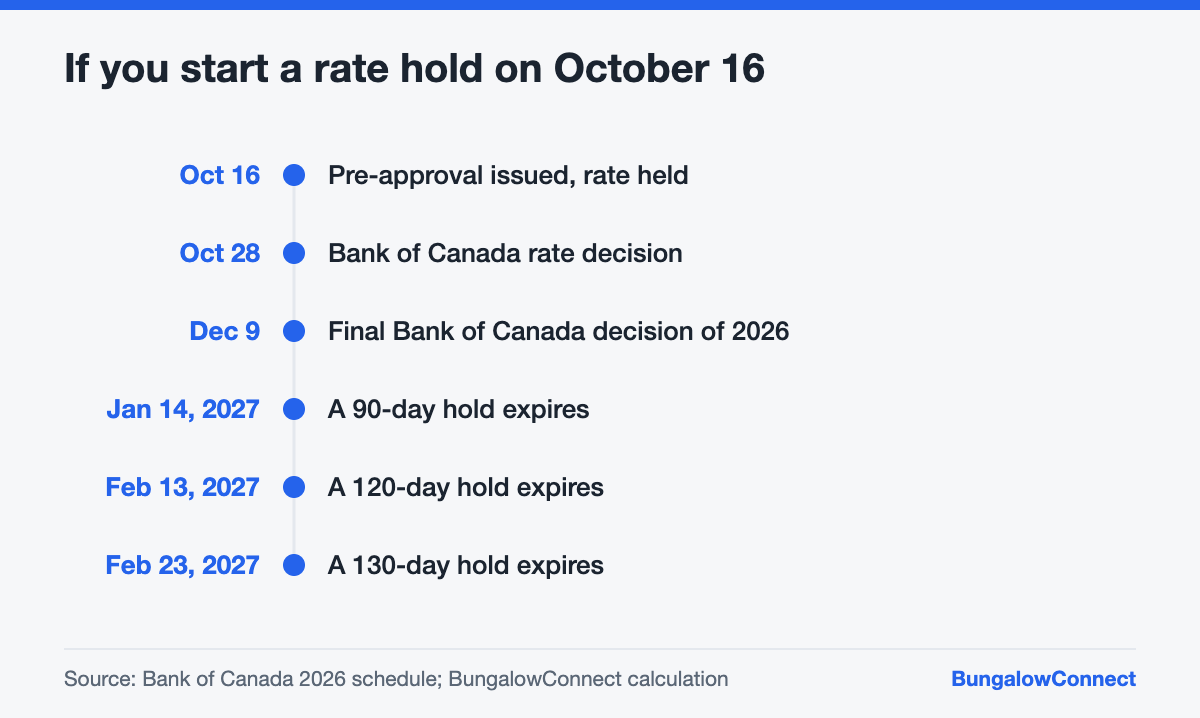
The date that matters is when the mortgage funds, which is your closing date. Bungalow sellers, particularly downsizers and estates, often ask for longer closings of 60 to 90 days. A hold started on October 16 that runs 120 days expires around February 13, 2027, and a 130-day hold around February 23. If you buy on December 1 with a 90-day close, you are outside it.
- Get pre-approved with a hold before you start offering.
- Write down the expiry date and the exact product the rate applies to.
- Match your offer’s closing date to the hold, or ask the lender for an extension before you sign.
- Once your offer is accepted, send the agreement to the lender immediately so it can issue a commitment.
- Ask whether the commitment rate can be reduced if rates fall before closing.
Fixed or variable while rates are in flux?
A held fixed rate protects you from bond-market moves. A variable rate hold usually locks the discount (for example, prime minus a set amount), not the rate itself, so your payment would still change if the Bank moves on October 28 or December 9. Neither choice is wrong. The right one depends on how much payment volatility your budget can absorb. Our comparison of fixed and variable mortgages for bungalow buyers walks through the trade-offs, and the mortgage calculators let you test your own numbers.
Already own and renewing instead? The same logic applies. Most lenders send renewal offers in advance, and you can usually hold a rate with a new lender ahead of your maturity date. See our 2026 renewal plan for bungalow owners.
Frequently asked questions
Does a mortgage pre-approval guarantee my rate?
It usually guarantees the rate for a set period if your mortgage funds within that window and nothing material changes in your finances. It does not guarantee the mortgage itself. The lender still has to approve the property, confirm your documents and, for an insured mortgage, get approval from the insurer before it issues a final commitment.
How long does a mortgage rate hold last in Canada?
Most lenders offer 90 to 130 days. BMO advertises 130 days on its pre-approval page, and National Bank says up to 120 days. Brokers and smaller lenders vary, and some charge or shorten holds when rates are volatile. Always confirm the expiry date in writing and compare it to your intended closing date.
Is there a cost to hold a mortgage rate?
Standard pre-approval holds from banks are generally free, and BMO’s page says there is no fee. The hidden cost is your time and credit check, which is minor. Holding rates with several lenders at once is common, although each one may pull your credit report, so ask whether it is a hard or soft check.
Should I wait until after October 28 to get pre-approved?
There is little reason to wait. If rates rise after October 28, a hold taken now protects you. If they fall, you can ask the lender to match the lower rate or simply get a new pre-approval. Waiting only makes sense if you are months away from buying and the hold would expire first.
Ready to start looking?
Once your rate is held, set up listing alerts for bungalows in your price range so you see new listings the day they appear, well inside your hold window.
This article is general information as of October 2026, not legal, tax, mortgage or financial advice. Rules and numbers change, so confirm the details for your situation with a licensed professional.