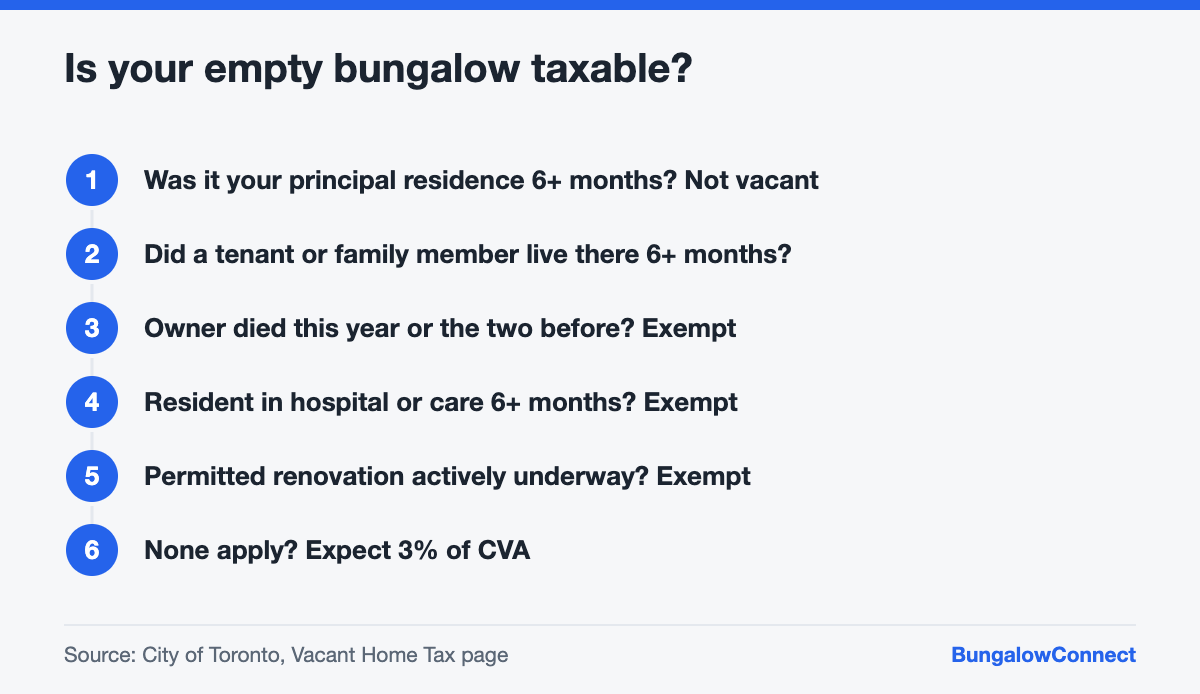
An empty Toronto bungalow is usually exempt from the Vacant Home Tax if it sits empty because the owner died, because the person who lives there is in hospital or long-term care, or because a permitted renovation is underway. If none of those apply and nobody lived there for six months or more of the year, the city charges 3% of the property’s assessed value. You must file a declaration every year either way.
Key takeaways
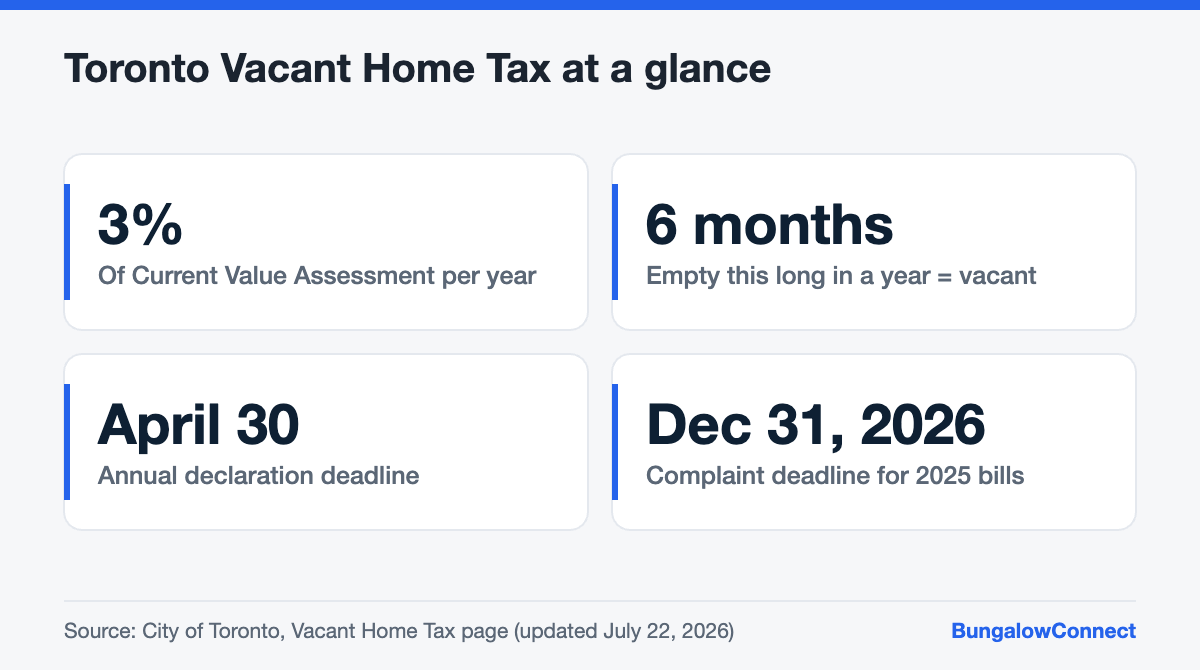
- The tax is 3% of Current Value Assessment, so $30,000 a year on a $1,000,000 assessment.
- A home is vacant if it was empty for six months or more in the year.
- Snowbirds are fine: your principal residence counts even if you travel for long periods.
- Estates, care-home moves and permitted renovations have specific exemptions with time limits.
- If you were billed for 2025 in error, the Notice of Complaint deadline is December 31, 2026.
Why bungalow owners get caught by this tax
Toronto’s bungalows are disproportionately owned by long-time owners, many of them seniors. That means more of these homes sit empty for life reasons: a parent moves to long-term care, an owner dies and the estate takes a year to settle (often with Ontario estate administration tax and probate paperwork along the way), or a new buyer guts a 1950s bungalow before moving in. Every one of those situations can produce a vacant-home bill if the paperwork is missed.
The bills for the 2025 tax year went out in June 2026, with instalments due September 15, October 15 and November 16, 2026. If you are reading this because one of those bills arrived, the complaint process below is your next step.
What counts as vacant?
Under the city’s rules, a residential property is vacant if it was empty for six months or more during the tax year. It is not vacant if, for at least six months of the year, it was:
- Your principal residence. The city defines this as where you live, receive mail and pay bills, and says it still applies if you leave for long periods for travel or work, which covers snowbirds.
- Rented to a tenant under written agreements of at least 30 days that add up to six months or more in the year.
- Lived in by family or friends as their principal residence, even rent-free.
There is a trap here: if no declaration reaches the city by April 30, the property is deemed vacant and billed, even if you lived in it all year. The city says owners must declare every year, including owners who live in the home.
Vacant Home Tax exemptions that fit bungalow situations
The City of Toronto’s Vacant Home Tax page (updated July 22, 2026) lists eight exemptions. These are the ones we see most with bungalows.
| Situation | Exemption | Time limit | Main proof |
|---|---|---|---|
| Owner died, house empty while the estate settles | Death of a registered owner | Up to 3 consecutive years | Death certificate |
| Parent moved to hospital, long-term care or supportive care | Principal resident in care for 6+ months | Up to 2 consecutive years | Signed facility letter and proof of prior residence |
| Gut renovation or rebuild of an older bungalow | Repairs or renovations | While permitted work is actively underway | Permits, project description, records |
| You bought this year and have not moved in | Transfer of legal ownership | The year the purchase closed | Land transfer deed |
| Court order prevents anyone living there | Court order | 6+ months of the year | Copy of the order |
The renovation exemption has three conditions
All of these must apply: occupation was prevented for at least six months, all necessary permits were issued, and the city judges the work to be actively underway without unnecessary delay. A bungalow emptied in spring while you “think about” a renovation, with no permits, does not qualify. A permitted second-storey addition that stalls for months can also be challenged.
The ownership-transfer exemption needs a full transfer
It applies only when 100% of ownership changed hands in the year you are declaring. Name changes, or adding or removing a co-owner (a common step when adult children go on title with a parent), do not qualify.
Tip: If a parent’s bungalow is likely to sit empty for a while, put three dates in your calendar now: the date they moved out, April 30 for the declaration, and the two-year or three-year exemption limit. When the limit runs out, the house needs a tenant, a family occupant or a sale, or the 3% tax starts.
What does the Vacant Home Tax cost?
The tax is 3% of the property’s Current Value Assessment (CVA), the value shown on your MPAC assessment notice and property tax bill. It is not based on what the house would sell for today.
- CVA of $900,000: $27,000 a year, or three instalments of $9,000.
- CVA of $1,000,000: $30,000 a year, or three instalments of $10,000.
- CVA of $1,100,000: $33,000 a year, or three instalments of $11,000.
Overdue amounts accrue interest at 1.25% on the first day of default and on the first day of each later month, and unpaid amounts can be added to the property tax roll. A false declaration, or failing to provide information the city asks for, can bring a fine of up to $10,000 on top of the tax. For the full picture of ongoing costs, see what it really costs to own a bungalow in Toronto.
Billed by mistake? How to file a Notice of Complaint
If you received a bill for 2025 and the bungalow was occupied, or qualifies for an exemption, you can dispute it.
- Gather proof: a death certificate, facility letter, permits, lease agreements, or utility and ID records showing it was your principal residence.
- File a Notice of Complaint with the city. For 2025 bills, the deadline is December 31, 2026. The deadline for 2022 to 2024 bills has passed.
- If the city audits you, submit the documents within 60 days of its letter.
- If you disagree with the complaint decision, you can appeal within 90 days. The appeal is decided in writing by the city’s Deputy Treasurer, and that decision is final.
Keep paying instalments while the complaint is reviewed if you want to avoid interest, and ask the city how any refund would be issued.
Selling an empty bungalow? Plan around the six-month line
An estate or downsizer who lists an empty bungalow should know that “for sale” is not itself an exemption for an ordinary owner (the vacant new inventory exemption applies only to developers). If the death or care exemptions do not apply, the clock matters. A house that is empty from May onward will cross the six-month line before year-end.
Options include a short written lease to a tenant, letting a family member live there, or pricing to sell before the threshold. If you are also deciding whether to buy a smaller home, our article on downsizing in a down market covers the timing. Your home value estimate is a good place to start if a sale is likely.
Frequently asked questions
Do I have to declare if I live in my bungalow?
Yes. The city requires every residential owner to declare occupancy status each year by April 30, including owners who live in the home full-time. If no declaration is received, the property is deemed vacant and the tax is charged. Most owners who declare on time as a principal residence pay nothing.
Does the Vacant Home Tax apply to snowbirds?
No, as long as the bungalow is your principal residence. The city says principal residence status applies even if you leave for extended periods for travel or work, and it specifically mentions snowbirds. You must still file your annual declaration, and the home must be where you live, get mail and pay bills.
How long can a house sit empty after the owner dies?
The death exemption can be claimed for up to three consecutive tax years: the year the owner died and the two years after it. After that, the property needs an occupant, a sale or another exemption, or the 3% tax applies. You will need a copy of the death certificate.
Does a basement tenant stop the tax if the main floor is empty?
The tax is declared per property, using the roll number on your tax bill, not per suite. If your basement suite does not have its own roll number, a tenant living there under a qualifying lease may affect the property’s status. Confirm your specific case with the city through 311 before relying on it.
Thinking about what an empty bungalow is worth?
If the plan is to sell, see recent results on our sold bungalow listings or browse Toronto bungalows to understand the market before you set a date.
This article is general information as of October 2026, not legal, tax, mortgage or financial advice. Rules and numbers change, so confirm the details for your situation with a licensed professional.