Fall is the best time to start a radon test in an Ontario bungalow, because Health Canada wants at least 91 days of a long-term test to fall within the heating season, when windows are closed and radon levels tend to be highest. Put a long-term detector on the lowest level where someone spends four or more hours a day, leave it for at least three months, and act if the result is above 200 Bq/m3.
Key takeaways
- Radon is the leading cause of lung cancer after smoking and causes 16% of lung cancer deaths.
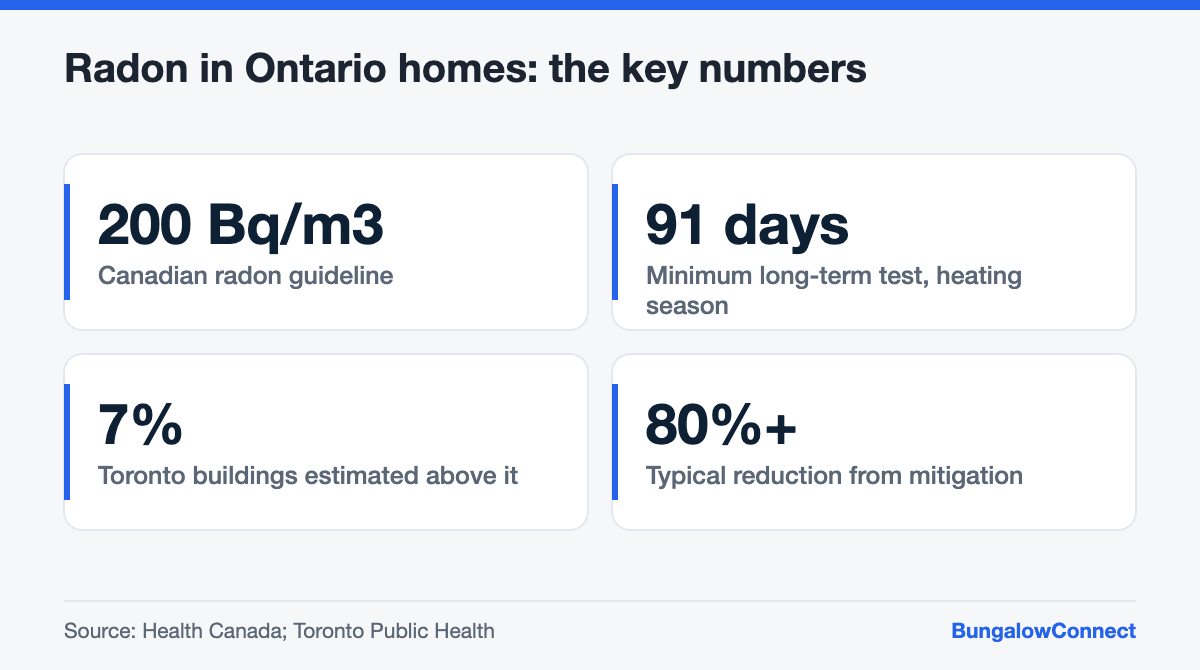
- Toronto Public Health estimates about 7% of Toronto buildings may have radon levels that pose a risk.
- Use a long-term test: at least 91 days, with that time in the heating season.
- In a bungalow, test the basement bedroom, rec room or suite if anyone uses it daily.
- Mitigation usually cuts radon by more than 80% and can often be installed in under a day.
What is radon and why does it matter in a bungalow?
Radon is a colourless, odourless radioactive gas that comes from the natural breakdown of uranium in soil and rock. It seeps into homes through foundation cracks, floor drains, sump pits and gaps around pipes, and it collects in enclosed spaces. You cannot see it or smell it, and the only way to know your level is to test.
Toronto Public Health says radon “is the leading cause of lung cancer after smoking” and estimates that reducing levels below the guideline could prevent about 10 radon-related deaths a year in Toronto alone.
Why bungalows deserve extra attention
- More foundation per square foot. A bungalow spreads its living space over one large footprint, so more of the house sits on soil than in a two-storey of the same size.
- People live in the basement. Finished lower levels, basement bedrooms and income suites are common in GTA bungalows, and raised bungalows often put the family room downstairs.
- Older foundations. Many GTA bungalows date from the 1950s to the 1970s, and decades of settling create cracks and gaps.
None of that means your bungalow has a problem. It means a test is worth the small cost.
How long should a radon test take?
Health Canada recommends testing for 3 to 12 months. Its guide for radon measurements in homes sets 91 days as the minimum for a valid long-term test and says at least 91 days of the test should be during the heating season.
Radon levels move around from day to day and season to season, so a short test of a few days is a snapshot, not an answer. If you start a long-term test on October 20, 2026, the 91-day mark is January 19, 2027. That timing is why fall is the natural moment to start.
Where to put a radon detector in a bungalow
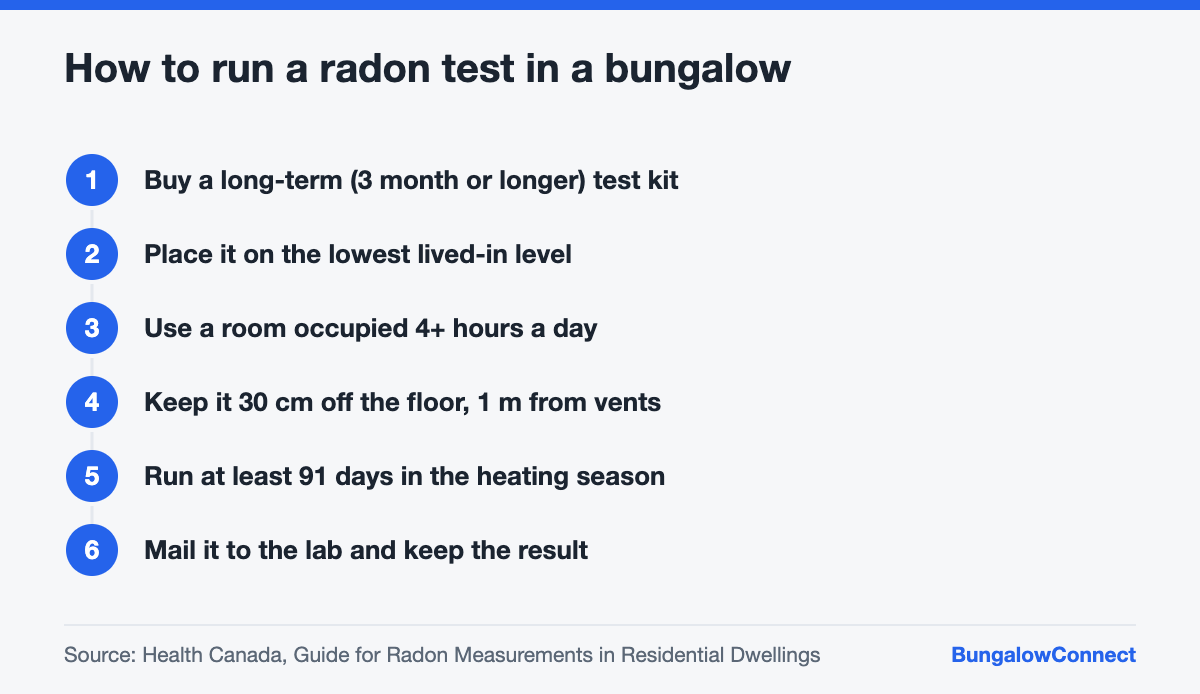
Placement is where most DIY tests go wrong. Health Canada’s guidance:
| Rule | What it means in a bungalow |
|---|---|
| Lowest lived-in level | The finished basement if anyone uses it; the main floor only if the basement is unfinished storage |
| Occupied 4+ hours a day | A basement bedroom, rec room, home office or suite living room |
| Not kitchens, bathrooms or laundry rooms | Humidity, fans and drafts can skew readings |
| At least 30 cm (1 ft) off the floor | On a shelf or side table, in the breathing zone |
| At least 30 cm from walls and 1 m from vents, windows and doors | Away from the furnace register and the egress window |
If you rent out a basement suite, the suite is usually the right place to test, because it is the lowest lived-in space. Agree on access with your tenant first, and share the result.
How to test: kits, labs and professionals
You have two options:
- Do it yourself. Toronto Public Health says long-term kits can be bought online or at many home improvement stores. Choose one that measures for at least three months and includes lab analysis. Follow the instructions, record the start and end dates, and mail it promptly.
- Hire a professional. Health Canada recommends using professionals certified through the Canadian National Radon Proficiency Program (C-NRPP). This makes sense if you want a digital monitor, multiple locations, or you are a landlord who wants a documented result.
Keep the lab report with your house records. A buyer may ask for it one day, and it is useful evidence if you later install a mitigation system.
Tip: A 91-day test will not fit inside a five-day home inspection condition. If you are buying a bungalow with a finished basement, ask the seller whether they have a long-term result, and plan to start your own test the first fall you own the home.
What if your radon level is above 200 Bq/m3?
Health Canada says to fix the problem within one year if the average is above 200 Bq/m3, and sooner if the level is higher. The most common fix is sub-slab depressurization: a pipe through the basement slab and a small fan draw radon from under the house and vent it outside before it can enter.
According to Health Canada’s radon reduction page, a system will reduce radon by more than 80% in most homes and can be installed in less than a day, at about the same cost as other common home repairs. Sealing major entry points, such as the sump pit, can help but is rarely enough on its own when levels are well above the guideline.
Help with the cost
- Toronto Public Health notes that Ontario’s new home warranty covers mitigation costs for homes under seven years old.
- It also points to the Canadian Lung Association and the Ontario Renovates Program as possible sources of financial help for eligible homeowners.
- Since January 1, 2025, new Ontario houses must include a rough-in for a radon mitigation system, which makes later fixes simpler in newer bungalows.
Radon and your other basement projects
If you are planning to finish a basement or add a suite, test before you close up the walls. Sealing the slab, adding a sump lid or roughing in a vent pipe is far cheaper during a renovation than after. The same goes for basement flooding protection: a sealed, gasketed sump lid helps with both moisture and radon.
Radon also belongs on the same checklist as smoke and carbon monoxide alarms. Our healthy home checklist covers the rest of the list.
Frequently asked questions
Is radon a problem in Toronto?
It can be. Toronto Public Health estimates about 7% of buildings in the city, including homes, may have radon levels that pose a health risk. Levels vary from house to house even on the same street, because they depend on soil, foundation condition and how the house is ventilated. The only way to know your home’s level is to test it.
Can I test for radon in summer?
You can, but the result is less reliable. Health Canada’s guidance says at least 91 days of a long-term test should fall in the heating season, when homes are closed up. A summer-only test may underestimate your annual average. If you test in warm months, consider retesting through the winter before deciding whether to mitigate.
Should I test for radon before buying a bungalow?
A proper long-term test takes at least three months, which does not fit most conditional periods. Ask the seller for any past results, look for an existing radon fan and pipe, and budget for a test after closing. If the level is high, mitigation is a routine fix, not usually a reason to walk away.
Does a radon system cost much to run?
Health Canada does not publish a running-cost figure, but the system uses a small fan that runs continuously, so expect a modest addition to your electricity bill. Ask the C-NRPP certified contractor for the fan’s wattage. Retesting after installation confirms the system is working as intended.
Looking for a bungalow with a finished lower level?
Browse raised bungalows for sale, which often have bright lower levels, and add a radon test to your first-fall to-do list once you move in.
This article is general information as of October 2026, not legal, tax, mortgage or financial advice. Rules and numbers change, so confirm the details for your situation with a licensed professional.